Friday, October 30, 2015

Godhra and after

The burning of a train in Godhra on 27 February 2002, at ------- AM (deep night)
It caused the deaths of 58 Hindu pilgrims karsevaks returning from Ayodhya.


Godhra town population comprises settled Sindhi Hindus who moved in from Pakistan & Ghanchi Muslims after partition (???). The relationship between Hindus and Muslims was apparently not that cordial right from the start, as Ghanchis were termed as very aggressive per some reading I did online.
Godhra town witnessed communal riots in 1947, 1952, 1959, 1961, 1965, 1967, 1972, 1974, 1980, 1983, 1989, 1990 and in 1992. 

Mohammad Hussain Kalota, acquitted for 'lack of evidence' was an independent President of Godhra corporation. Earlier he worked for Congress minority cell for six years. On May 10, 2001,Kalota had given an ad in a Gujarati paper  thanking Congress for getting him elected Kalota was a district convener of minority cell of Congress. Salim Sheikh (absconding) was the youth Congress VP and Haji Bilal (Convicted) was associated too. Kalota had links also with Tablighi Jamaat, which had former Pakistan president Rafiq Tarar as its member. This Tablighi founded Harkat, a Jammu & Kashmir terror org  which claimed responsibility via an email for Delhi blasts of 07-09-2011. Thus the main accused in the Godhra genocide, Mohammed Hussain Kalota, has been a "Congressman and a protege of a sitting Congress legislator"
Initial reports on February 27 presented the incident as a pre-planned Muslim mob attack on the Sabarmati Express train against "innocent" Hindu activists who had begun traveling from the city of Ayodhya. However, as the facts began to trickle out, a different picture has emerged.
 a group led by a few members of the Indian parliament who are trying to get the facts straight about the issue. It is headed by Dr. Amar Singh, a member of parliament from Samajwadi Party, who spoke with two of the Hindu victims of the train-burning incident in Godhra. They revealed that, "all along the journey these Ramsevaks (the Hindu militants) were behaving like Gundas (thugs). They wouldn't pay for what they had bought from the vendors. On stations they would chant anti-Muslim rhymes and slogans, insulting Muslim Holy places. There was teasing as well of both fellow passengers and women on the platforms." This fact-finding delegation, comprised of Rajbabbar (M.P. Samajwadi), Shabana Azmi (M.P.) and Aziz Burni (Editor of a leading Urdu news paper, Rashtriya Sahara), was one of the first groups to arrive in the strife-torn area. They visited the hospital and there they found these two victims (from a Hindu family) of the Godhra incident.


Wednesday, October 28, 2015

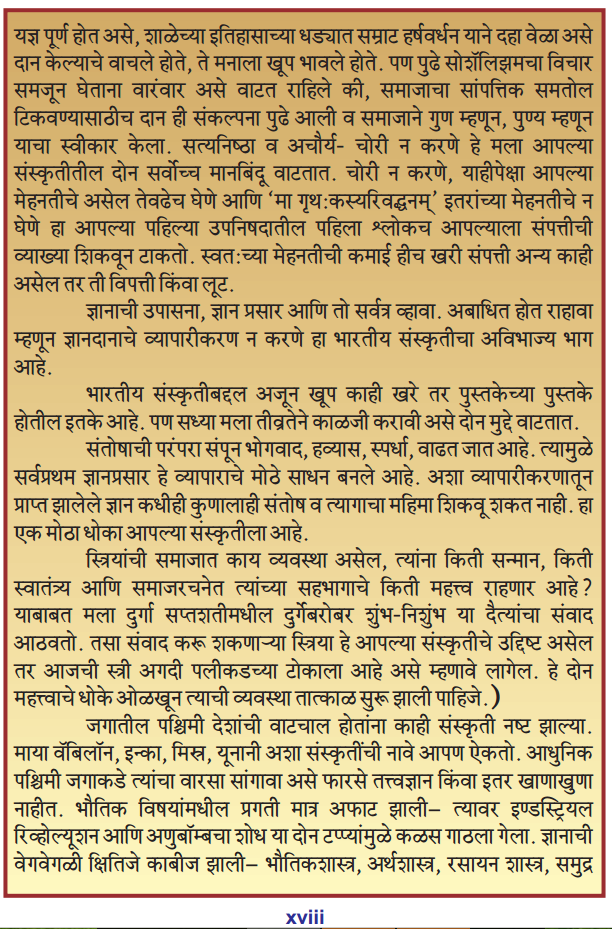
सलील गेवाली यांच्या पुस्तकासाठी प्रस्तावना

सलील गेवाली यांच्या पुस्तकासाठी प्रस्तावना
राष्ट्रचेतना

कोटि कोटि वर्षोंपूर्व कभी इस ब्रह्माण्डमें पृथ्वी नामक एक नया ग्रह बनता है और सूर्यमालिकामें अपनी
कालक्रमणा करने लगता है। इसके लाखों वर्षोंपश्चात् किसी समय यहाँ जीवसृष्टि का उदय होता है । उस
अपरिमित जीवसृष्टिका एक जीव है मानव । अन्य सजीवोंमें प्रकट होनेवाले उसी चैतन्यकी धरोहर लिये, लेकिन
वैचारिक क्षमतामें शायद उन सबसे कई युग, कई योजन आगे। यही मानव विचार करता है और पूछता है --
क्या यह चैतन्य जीवसृष्टिके साथ अवतरित हुआ या कि वह ब्रह्माण्डमें पहलेसेही विचरण करता था ?

मानवकी विचार-क्षमतासे आरंभ होती है इस प्रकारके प्रश्नोंकी मालिका। पहला स्वाभाविक प्रश्न है कोsहम् --
मैं कौन हूँ और इसका अन्तिम सत्यात्मक उत्तर है सोsहम् -- मैं वही हूँ।

वही याने कौन ?और मैं कौन से आरंभकर मैं वही हूँ इस ज्ञान तक पहुँचनेकी कालगणना कितनी लम्बी है ?
उस ज्ञानतक पहुँचने के लिये कितनी अधिक वैचारिक प्रगल्भता चाहिये ? भारतीय दर्शन बताता है कि
मैं कौन से आरंभ होनेवाला यह प्रवास विचारोंसे प्रेरित तो है परन्तु इसकी समाप्ति विचारोंसे नही बल्कि
अनुभूतिसे होती है। भारतीय संस्कृति बताती है कि अनुभूति पानेे लिये गुरू ही आधार है -- प्रथम गुरु स्वयं श्री
शिव हैं। इसी लिये गुरुकी महिमा है -- गुरुर्साक्षात् परब्रह्म तस्मै श्री गुरवे नमः ।।

यह अनुभूति जब एक व्यक्तिकी थाती बन जाती है तब क्या वह वैश्विक हो जाती है ? क्या वह सार्वजनिक साझा
की जा सकती है ? नही। हर मनुष्यको अपनी यात्रा स्वयं करनी है -- प्रश्नसे विचार तक और विचारसे अनुभूति तक -- लेकिन हाँ, एक गुरु जो अनुभूति तक पहुँच चुका है, वह साधकको राहकी कठिनाईय़ाँ और पडाव (विरामस्थल) बता सकता है, आरंभमें हाथ पकडकर थोडी दूर चला सकता है। और यदि गुरु समर्थ हो तो साधकको अनुभूति की कगार तक ले जा सकता है। लेकिन जो अन्तिम सत्य जानना है उसके लिये साधकको स्वयं ही पूरे प्रयास लगाकर वहाँ पहुँचना पडता है। वह चैतन्य जो सभी जीवोंमें विराजमान है, यह उस चैतन्य का गुण है कि साधकको अनुभूतितक प्रेरित करता रहे। लेकिन इस राह के पडाव भी लगभग अनन्त हैं। सामान्य जीव कुछ को पार कर ही लेता है। और उसी काल में वैचारिक प्रगल्भता बढती चलती है जो स्वाभाविक रूपसे आधिभौतिक उँचाइयाँ भी देती है जैसे संगीत, गणित, खगोल, निसर्ग, राज्यशास्त्र इत्यादि।

इस प्रकारका दर्शन भारतमें उदित हुआ। उसे पूर्णता आते आते भी सहस्त्रों वर्ष लग गये। उसके विषयमें भगवद्गीता का कथन -- स कालेनेsह महता योगो नष्टः परंतप -- क्या एक ही बार हुआ या कई कई बार हुआ ? जो भी हो, लेकिन वह दर्शन और जीवात्माके सोsहम् तक पहूँचनेके पडावोंका जो वर्णन अलग-अलग अनुभूति-सिद्ध पुरुषोंने किया है, वही पूरे भारतवर्षकी थाती है --वही हमारी संस्कृति है। पर इस बातको वही समझेंगे जो इसे गुनेंगे।

भारतीय संस्कृतिके इस प्रदीर्घ प्रवासमें वह टिकी रही। ज्ञान भले ही विलुप्त होता रहा हो, परन्तु संस्कृति बनी रही। लेकिन क्या आज यह विलुप्तिके कगारपर है ? यदि हाँ, तो कितना समय है अपने पास कि इसकी फिसलनको रोक सकें और इसे पुनः दृढमूल करें?

लेकिन उससे पहला प्रश्न यह आता है कि क्या संस्कृति आधुनिकताके विरुद्ध होती है ? क्या भारतीय संस्कृति आधुनिकता की विरोधी है ? वह आधुनिकता जिसकी चाहना हम सबको है। क्या भारतीय संस्कृतिके नष्ट होनेसे ही भारतके लिये आधुनिकता और विकासके द्वार खुलेंगे ?

(अपूर्ण)


Monday, September 28, 2015

Dharma and Secularism

Secularism Western, Dharma Indian solution: Rajiv Malhotra


By Ajeet Bharti
It is often believed that the idea of secularism is universal and so it should be applied. However, Rajiv Malhotra, noted Indologist and author of several books on the issues of Dharma, Indian history, culture, and languages, believes that the concept is a Western creation. Yesterday, he shared a video on his Facebook page, where he emphasised on the point that ‘secularism’ was a solution to the problems of West where religions like Christianity propagated the thought of ‘we are the only religion that is right, others are wrong’.
That meant there was no scope of a dialogue in a society that heavily relied on the directives of the Church, which guided police, society and even the reigning monarchs.
He said, “Secularism is a Western concept, to solve a western problem. The problem in Western religion was the ‘exclusivity claim’, which means ‘only I am right, others are wrong’, which is built into the Western religion.”
Stressing further on the power that religion and the Church enjoyed, he said that religion often interfered with science and persecuted people who fiddled away with its own thoughts. The Church didn’t allow even science to have its own independent inquiry.
The Indologist, when asked about whether it was unreasonable to define India as Hindu Rashtra in modern times, continued to elaborate on what Dharma meant and how it was different from European view of religion and the need of secularism as a solution.
“Secularism was to curtail the excessive ‘state authority’ and ‘state power’ that the Church had, not only over the people who dissented and belonged to some other religion, but also people who were scientists.”
However, he said, “In India, the Dharma never had a posture against scientific inquiry. The Raja (King) never had an authority to impose his dharma over others. Manu was very clear that Raja must practice his Dharma, and he must allow others to practice their Dharma. In fact, not only it’s theoretically the case, but (even) in practise like, when the early Syrian Christians came, the Raja even gave them land. When the Zoroastrians from Persia came to India, they were also given land to live and practice their religion.”
Adding to the concept of dharma and how it is pluralistic in nature, Malhotra talked about how Hinduism was not a religion as defined by the West, “Hinduism is not necessarily a religion in a Western sense, it got a lot of claims within it. There are people who believe in different philosophies… there are people who are atheists, which is also ok, you can be a nāstik (atheist).”
The Indologist further explained how concept of religion with regards to Hinduism and Dharma, was different from the Abrahamic religions. “There is a built-in ‘pluralism’ within the Dharma (which) has made it different than the built-in ‘exclusivity’ in the Abrahamic religions.”
“Now, if the Dharma has a built-in pluralism (Sāpeksha Dharma), which means inclusive of all the Dharma, Sufis can have their Dharma, Muslims can have their Dharma, as long as you also respect others to have their Dharma. We can have differences (but) with mutual respect,” he elaborated.
Saying that Dharma meant a flow of free thinking and not a limitation on the same, Rajiv Malhotra debunked the idea of secularism for India as he opined it was a solution for the Western problem where scientists were beheaded and dissidents were persecuted.
As he spoke on the topic, in reply to the question of secularism and Dharma, he remarked that Dharma “never said that if your scientific conclusion is different then you are disobedient and it’s blasphemy. We never had any blasphemy law kind of things. So, free thinking was always there.”
Later, adding on to why pluralism was best suited to us, he said, “Lot of Indians believe that secularism is a “gold standard’ because they have been brainwashed. They don’t even think what it is, where it came from, what does it do. They are just taught that way. They have learnt it from childhood and parroted it saying ‘ain’t we seculars’, this and that.”
Malhotra explained that secularism, as an idea, was needed because the Western society didn’t have a space for any other religion. They needed a concept where people tried to coexist and practice different faiths. They needed an idea where science and other religions could coexist and be tolerated. However, he said that in India there were no such issues as pluralism made sure we have mutual respect.
Answering to the second part of the question regarding India being a ‘Hindu Rashtra’, he said, “As far as would India be a Hindu society, I use the term Dharmic society. India is a Dharmic society and I do not use the word Hindu, because Dharma also includes Buddhists, Jains, Sikhs. It includes anyone who complies with the basic principles like mutual respect.”
“So, the people who themselves want to be called as Hindus are fine, or something else are also fine. But, if you use Dharma, then Yes, Indian civilization is a Dharmic Civilization. This is my position,” he asserted.
The author of ‘Breaking India’, ‘Indra’s Net’ and ‘Breaking Point’, was asked whether he meant that the alternative name to be asked for India should be a Dharmic Nation rather than Hindu Rashtra.
Rajiv replied in a candid way, “I think it would be very difficult for someone to reject Dharma, no matter who they are, because basic ethics, basic responsibilities, basic life-style of respecting yourself, your family, your community, animals, nature, society, the world, the environment are all part of Dharma. Dharma is not just religion between me and God, it is all encompassing human ethics and responsibility.”
Here is the link to the YouTube video from his speech in December 2014:

Thursday, August 27, 2015

The Dharma-culture-economy -globally

From Srinivas Bharadwaj <srini.bharadwaj@gmail.com
 The various models of Dharmic Resistance over the centuries have included importantly 
Meijism. In the 19th Century, Japan, began a switch from a traditional Dharmic to an Industrial
post-agrarian society. Meijisim adopted several of the new technologies while also retaining its
older perspectives and built the first successful evolution of a Dharmic Industrial Society. China,
on the other hand evolved down a different road, having turned to Communism and taking with it,
several of the East Asian Societies.

   India was a late entrant to this party and its first turn was to take a quazi-socialist turn in the form of
a Gandhian Socialist model which was evolutionary rather than revolutionary in the transformation of
India. The bipolar nature of the world's economic models, namely Capitalism and Socialism, left military
and geo-political concerns foremost in the minds of planners. Hinduism itself was absorbed with 
some approval and even a little awe notably with the Beatles and Ravi Shankar fitting easily into the 
Western Cultural Ethos. Culture was seen as important only in its ability to combat communism. In this
respect, Islam was seen as a key counterpoint to Communism. And its resistance to transformation was not
seen as important. Expediency drove Western intentions to influence and transform foreign civilizations. 
Earlier the need to conquer and occupy had driven the need to convert the natives of places like 
South America, Southern America. 

 Post-Soviet Union, and the rise of China, a new set of concerns emerged. Europe began to diverge in
its perspectives, notably separating its economic and culture interests. However, one lesson learned in
the transformation of the Soviet Union was the "Billy Graham" and Pope John Paul II Crusades. It was felt that Christianity had a key role to play in the transformation into "our model". Multi-culturalism in the real sense
implied an acceptance of cultural values and the way forward for this process was also going to be Christian
Evangelism. 

The rise of the BJP lead to a key Western Concern with respect to India, namely that it was headed towards
fundamentalism. Once Modi came to power and it was understood that he would follow a proReform economic
agenda and have in place some progressive principles, it became clear that the battle in the West was going
to move towards a bifurcation of policy, namely encourage Buddhism but discourage Hinduism. The broad 
push in Europe has been towards a drop in interest in Christianity, despite a new Pope. The trend towards
Atheism in Britain is seen as having contagion effects. The recent Internatinoal Yoga Day effort was received
with some resistance in the West.

Protestant Evangelicals notably in the Southern Denominations have seen India as a key next step, notably 
as unfinished work. Yet, there is a need for both sides to build a key dialog that is more substantive. The 
problem is that there is not an organized set of leaders able to facilitate this. The problem is a lack of coordination in defining the key issues and the key players. Academia necessarily is used as a "guerrilla agency" like the CIA is in military intelligence. It does not toe the line of any traditional religious body. 
The religious bodies will talk. 

The ability to engage academia or more importantly, get academia to talk back to you is part of the problem.
Today, a few individual actors with a free license can operate boldly. The question is why this ability is not 
properly harnessed and applied appropriately from the other side, beyond a few players. The "Operatives" model, where a few aim to drive an opinion into the world that then sticks needs to be appropriately managed. 
Asking questions and defining a method of engagement and dialog needs to be initiated.

For instance, an open dialog with various Religious Studies departments in the Ivy schools against the back
drop of the Dharma Conference is called for. I feel that there should be an open invite to Select Professors
to freely come to the Conference and have an open dialog and discussion with an "Open House" is called for.
In the East coast, this should not be difficult to arrange.
COMMENT BY Come Carpentier comecarpentier@gmail.com
 Japan in the wake the Meiji revolution embarked on a course of military expansion and colonisation inspired by the western powers and that brought about its undoing as its refined Dharmic civilisation was engulfed in the savagery of modern techno-warfare and has now been diluted by sheer consumerism.

The dialogue with academics is needed but the problem is that university trained intellectuals are expected and even compelled to work under certain methodologies and theories which don't accept the Dharmic principles as anything more than a pre-industrial society's caste-based rules. They must be made to look outside the frameworks of deconstructionism, dialectical materialism and liberal empiricism and the insights of the physical and biological sciences such as quantic physics and organic chemistry can help to change the perspective. 

Western missionary movements of course are much harder to influence because they work on semi-militaristic lines and don't rely on reason or analysis but merely on the "commercial" need to conquer markets and win over bodies and minds.

By Vamadeva Shastri (Dr. David Frawley)
Western academia has had an almost uncritical control of Hindu studies, unlike that of any other religion. There are few practicing Hindus in academic positions in the West, and those that exist rarely challenge the dominant discourse openly in front of their peers. Indians seem to be encouraged if they are Marxists or Non-Hindus. This is very different than Christianity, Judaism and Islam that have many practicing members in the ranks of academic teachers in the West, who openly defend their faith.
Western academics can denigrate Hinduism in often unkind terms, yet feel that Hindus should not be allowed to criticize them in return, as if they should be immune from scrutiny by the Hindu community.
There is a new battle over Hindu studies and what Hinduism means in a global context, particularly since India now has what is regarded as a more pro-Hindu government. The popularity of Hindu based movements worldwide like the many different Yoga groups, Vedanta and Ayurveda are part of this issue. While Hinduism is being denigrated at an academic level as backward and superstitious, Hindu based ideas are at the forefront of much of the new spiritual, healing and ecological thought in the world.
Current views of Hinduism that predominate in academia follow colonial, missionary, Marxist and Freudian perspectives that have largely been discredited in other fields and which most Americans would not embrace. There are rarely any dharmic, yogic, Vedantic or Hindu perspectives taken up in so-called Hindu studies. Hindus today – like Blacks and the Native Americans up to recent times – find that academic views of their culture and history are controlled by outside groups with vested interests that seem biased against them.
The recent attack on Malhotra reflects long term academic distortions in the field of Hindu studies. As someone who has written in the Vedic and Hindu field for over thirty years, I have found such insensitive attitudes towards Hindu scholars common in certain circles, which generally write on Hinduism without respecting or deeply studying Hindu traditions.
While Americans today have learned to respect the Hindu-American community – which is one of the most affluent and educated minority groups in the country – they would be surprised to know that much of American academia, which is supposed to represent tolerance, still treats them in a demeaning manner. It is important that a Hindu point of view must be allowed, even if it may be critical of accepted academic ideas, which as these currently stand can hardly be called considerate of any Hindu point of view.

Tuesday, July 7, 2015

दादा धर्माधिकारी, रावसाहेब कसबे आणि भाऊ तोरसेकर

दादा धर्माधिकारी, रावसाहेब कसबे आणि भाऊ तोरसेकर

 थोर समाजवादी विचारवंत दादा धर्माधिकारी यांचे नाव आजकाल कुठे फ़ारसे ऐकू येत नाही. 

समाजवादी चळवळीचे स्वातंत्र्योत्तर काळातील लहानमोठे नेते दादांनी घडवले म्हटल्यास वावगे ठरू नये. 

दादांच्या व्याख्याने व प्रवचनातून १९६० च्या दशकात नावारूपास आलेल्या अनेक समाजवादी नेत्यांना घडवले होते. 

मात्र पुढल्या काळात सक्रीय राजकारणापासून अलिप्त झालेल्या धर्माधिकार्‍यांनी उर्वरीत आयुष्य विनोबा भावेप्रणित सर्वोदय आंदोलनाला वाहून टाकले. 

त्याच सर्वोदय संघातर्फ़े दादांचे एक छोटेखानी पुस्तक प्रसिद्ध झालेले होते. 

‘दादांच्या बोधकथा’ असे त्याचे नाव. 

कुठलीशी आख्ययिका, दंतकथा किंवा व्यक्तीगत अनुभव थोडक्यात सांगून, त्याचे तात्पर्य वा बोध त्यातून दादांनी कथन केलेला असल्याने थोडक्यात महत्वाचे असे हे पुस्तक आहे. 

४०-५० पानांचे हे छोटेखानी पुस्तक आज कुठे मिळते किंवा नाही, ठाऊक नाही. 

पण ज्याला कुणाला पुरोगामी वा सेक्युलर विवेकवादी कार्य करायचे असेल, 

त्याच्यासाठी ती गीताच म्हणायला हरकत नाही. 

त्यातच दादांनी कानपूरच्या एका अनुभवाचे कथन केलेले आहे. 

कालपरवा प्राध्यापक रावसाहेब कसबे या पुरोगामी विचारवंताने 

सत्कारप्रसंगी जे मनोगत व्यक्त केले, 

ते ऐकून दादांची अशीच बोधकथा आठवली.

 किंबहूना रावसाहेब म्हणाले, तेच तर त्या बोधकथेचे सार आहे. 

सूडबुद्धी क्रांती नासवते, 

असे तात्पर्य दादांनी त्यात सांगितले आहे. 

पण त्यांनी घडवलेल्या नेते व त्याही पुढल्या पुरोगामी कार्यकर्त्यांना 

दादांकडून बोध घेण्याची गरज वाटली नाही 

आणि आता क्रांती पुरती नासून गेली आहे. 

असे होऊ शकते याचा इशाराच दादांनी आपल्या बोधकथेतून दिलेला होता 

आणि आता तीच पुरोगामी चळवळ नासून गेल्यावर 

वेगळ्या शब्दात कसबे यांनी त्याचाच पुनरूच्चर केला आहे. 

महाराष्ट्रातील पुरोगामी चळवळीच्या अस्ताचे त्यांचे विश्लेषण सूडाची कथा सांगणारेच आहे.

एका रात्री उशीरा दादा धर्माधिकारी कानपूरला रेल्वेने पोहोचले होते आणि अपरात्री त्यांना रिक्षा घेऊन मुक्कामाला जाण्याचा प्रसंग आला. 

त्या नीरव शांततेत रस्त्यावरून रिक्षा दौडत होता आणि भोवतालची शांतता दादांना अस्वस्थ करून गेली. 

म्हणून त्यांनी रिक्षाचालकाला बोलते करण्याचा प्रयास केला. 

त्याच्या मनात काय विचार घोळत आहेत, त्याची विचारणा केल्यावर त्याने बराच वेळ टाळाटाळ केली.

 पण खुपच आग्रह झाल्यावर तो मनमोकळा बोलून गेला. 

आमच्या पिढ्यानुपिढ्या अशाच कोणाला तरी वाहून नेण्यात खर्ची पडल्या. 

आम्हाला कधीच साहेबासारखे जगता आले नाही. 

तीच इच्छा मनात कायम आहे. 

त्याला नेमके काय म्हणायचे आहे म्हणून अधिक विचारणा केल्यावर तो स्पष्टच उत्तरला, 

तुम्ही रिक्षा हाकाल आणि मी मागे बसलेला असेन, असा दिवस कधी उजाडेल, असा विचार मनात घोळतो आहे. 

त्याची अपेक्षा वा इच्छा सुखवस्तू होण्याची असल्यास गैर नाही. 

पण त्यासाठी मागे बसलेल्या प्रवाश्याने कष्टाचे काम उपसावे आणि आपण चैन करावी, ही सूडबुद्धी झाली. 

जणू तो मागे बसलेला प्रवासीच आपल्यावरचा अन्यायकर्ता आहे 

आणि त्याच्या कष्ट वा कमीपणात आपले सुख वा यश बघण्यात सूड असतो. 

आपल्या वेदना दुसर्‍याला व्हाव्यात, ही अपेक्षाच सूडाची असते. 

मग ती भावना वा अपेक्षा आपला विकास वा प्रगती घडवून आणत नाही. 

की आपल्याला प्रगल्भ बनवत नाही. 

उलट सुखवस्तू असेल त्यालाही दीनवाणा बनवू बघते. 

कुणाला तरी हीन लेखण्याचा अधिकार वा शक्ती असावी, ही अन्यायमूलक भुमिका त्यातून पुढे येते 

आणि पर्यायाने समतेच्या लढ्यालाच किड लागते. 

आपल्या प्रगतीपेक्षा दुसर्‍याच्या अधोगतीम़ध्ये आनंद शोधण्याची 

वा गुलामीतून मुक्त होण्यापेक्षा दुस‍र्‍याला गुलाम करण्याची मानसिकता. 

नेहमी समतेचा लढा नासवून टाकते. 

थोडक्यात अन्यायाचे निर्मूलन मागे पडते आणि अन्याय करण्याचा अधिकार हे साध्य बनून जाते.

त्या रिक्षावाल्याच्या मनात असे विचार कुठून आले? 

त्यात सूडबुद्धी सामावलेली आहे, याचे त्याला भानही नसावे. 

पण आपल्यावर कोणीतरी अन्याय केला आहे आणि आपल्याला त्याचा बदला घ्यायचा आहे, अशी त्याची धारणा कशामुळे झाली?

 पुरोगामी चळवळ विस्तारताना 

समाजातला उच्चभ्रू वर्ग आपला शत्रू आहे, 

कारण तोच आपला शोषक आहे; 

अशी जी सोपी मांडणी होत गेली, 

त्यातून मग अशा धारणा सामान्य माणसाच्या मनात आकार घेत गेल्या, घर करत गेल्या. 

त्यातूनच मग त्या रिक्षावाल्याने अशी इच्छा अत्यंत निरागसपणे बोलून दाखवली. 

पण तोच पुरोगामी व समतेच्या लढ्याला संभाव्य धोका असल्याचे दादा धर्माशिकारी यांना जाणवले होते. 

त्यांनी आपल्य बोधकथेतून त्याचे आटोपशीर विवेचनही केलेले होते. 

सर्वोदय संघाने त्याचे पुस्तकही छापलेले होते. 

पण किती समाजवाद्यांनी त्या कथा वाचल्या आणि त्यापासून कोणता बोध घेतला? 

बोध घेतला असता, 

तर आज कसबे म्हणतात तसा 

पुरोगामी चळवळीचा र्‍हास कशाला झाला असता? 

कसबे काय म्हणालेत?

 ‘'मराठ्यांनी 

कायमच 

दलितांच्या खांद्यावर 

बंदुका ठेवून 

ब्राह्मणांवर गोळ्या झाडल्या.’ 

मागल्या अर्धशतकात महाराष्ट्रामध्ये पुरोगामी राजकारण झाले, असे आग्रहपुर्वक सांगितले जाते. 

पण ते राजकारण फ़क्त सत्तेभोवती घुमत राहिले 

आणि त्यासाठी 

ब्राह्मणद्वेष 

ही प्रेरणा बनवण्यात आली. 

मग त्यात 

महारांच्या 

म्हणजे 

दलितांपैकी जागृत मागास जातीला 

मराठ्यांनी हत्याराप्रमाणे वापररून घेतले. 

आपला ब्राह्मणद्वेष लपवून 

दलितांच्या आडोशाने 

जातीय सूडाचे 

राजकारण खेळले गेले 

असेच कसबे यांना म्हणायचे नाही काय? 

पण त्यालाच पुरोगामीत्व ठरवताना 

अनेक पुरोगामी ब्राह्मणही 

हिरीरीने पुढे आलेले होते. 

थोडक्यात ब्राह्मणवादाच्या थोतांडाला 

संपवण्याचा पवित्रा घेऊन 

प्रत्यक्षात ब्राह्मण्य 

मराठ्यांनी अवगत केले. 

तेच नवे ब्राह्मण बनत गेले.

म्हणजे जी विषमतेची खाई होती, 

ती भरण्याचा प्रयत्न बाजूला पडला 

आणि ब्राह्मण विरोधात 

पुरोगामी चळवळ नेवून 

नवे वर्चस्ववादी प्रस्थापित होत गेले. 

बाकीचे सर्व तसेच्या तसेच राहिले. 

पिछडे-मागास व गरीब आहेत तिथेच राहिले 

आणि जातीच्या व्याख्येत बसणार नाही, 

असा नवा वर्चस्ववाद उभा राहिला.

 त्याचे नेतृत्व 

माळी व मराठ्यांकडे 

आणि आघाडीवर झुंजायला 

महार 

ही जागृत दलित जात 

पुढे करण्यात आली. 

म्हणजे त्या बोलक्या 

दलित जातीच्या लढवय्यांनी 

ब्राह्मणांना 

पुर्वाश्रमीच्या अन्यायासाठी 

सतत झोडून 

खच्ची व नामोहरम करायचे 

आणि दुसरीकडे 

शहरापासून खेड्यापर्यंत 

नव्या उच्चवर्णिय मराठ्यांचे 

वर्चस्व प्रस्थापित करायचे. 

एखाद्या प्रसंगी वेळच आली, 

तर खर्‍या पुरोगामी 

पण जन्माने 

ब्राह्मण असलेल्याचाही

बळी दिला जाऊ लागला. 

स्वातंत्र्योत्तर काळात घटना समितीमध्ये 

काकासाहेब गाडगिळांनी 

हिंदू कोड बिलाच्या चर्चेत 

खंबीरपणे बाबासाहेबांचे समर्थन केलेले होते. 

पण पुढल्या काळात गाडगिळ वा त्यांच्या वारसांनाही 

मराठ्यांकडून 

‘राज्यात; ब्राह्मण म्हणून 

पक्षपाती वागणूक मिळत गेली. 

टिपून व वेचून 

ब्राह्मण 

बाजूला करण्याचे डावपेच योजले गेले. 

त्यासाठी धुर्तपणे सत्तेच्या वर्तुळात आणलेल्या 

जुन्या रिपब्लिकन नेत्यांचा 

वापर करण्यात आला. 

जणू पेशवाईचा सूड घेतल्यासारखे 

मागल्या अर्धशतकातील 

मराठी राजकारण झालेले आहे. 

मात्र त्याबद्दल खुलेपणाने बोलायचेही धाडस 

या कालखंडात ब्राह्मणांना उरले नाही. 

त्याचा शेवट 

संभाजी ब्रिगेडसारख्या 

उघड ब्राह्मणद्वेष करणार्‍या 

झुंडशाहीपर्यंत येऊन पोहोचला. 

मात्र सामान्य जनतेनेच 

त्याला अखेर मतदानाने लगाम लावला. 

पुरोगामी मुखवट्यातले हे सूडाचे राजकारण 

स्वत:ला समाजवादी म्हणवणारे 

ब्राह्मण बुद्धीमंतही थोपवू शकले नाहीत.

 ते जनतेनेच उधळून लावले. 

पण त्यात 

अवघी पुरोगामी चळवळ 

पुरती उध्वस्त होऊन गेली.